
Magento Open Source vs Adobe Commerce in 2027: Features, Costs & Alternatives
Choosing between Magento Open Source vs Adobe Commerce isn’t simply a matter of comparing a free ecommerce platform with a paid one. Both share the same powerful foundation, but Adobe Commerce introduces advanced B2B functionality, customer segmentation, content staging, loyalty programs, and enterprise tools that can significantly change how a business operates.
Does that mean Magento Open Source is the weaker choice? Not necessarily. Many Adobe Commerce features can be added to Open Source through third-party extensions, often without the expense of an enterprise license. The real question is which capabilities your business needs and how much you’re willing to invest in them.
In this Magento Open Source vs Adobe Commerce comparison for 2027, we explore exclusive and shared features, pricing, scalability, and practical alternatives to native enterprise tools. You’ll also discover how to extend Magento Open Source with additional functionality and determine which edition offers the best value for your ecommerce business.

Table of contents
- Magento Open Source vs Adobe Commerce Features: What’s Missing in Open Source & How to Get It?
- What Features Do Magento Open Source and Adobe Commerce Share?
- Magento Open Source vs Adobe Commerce: Key Differences Explained
- Final Words: Magento Open Source or Adobe Commerce — Which Should You Choose in 2027?
- Magento Open Source vs Adobe Commerce FAQ
Magento Open Source vs Adobe Commerce Features: What’s Missing in Open Source & How to Get It?
The biggest difference between Magento Open Source vs Adobe Commerce is the availability of advanced B2B, merchandising, personalization, loyalty, and enterprise management tools. However, many Adobe Commerce-exclusive features can be added to Magento Open Source through third-party extensions or custom development.
The following comparison covers the core differences in 2027, primarily for Adobe Commerce on-premises and cloud infrastructure (PaaS). Some capabilities require the Adobe Commerce B2B package or additional services.
| Unique Adobe Commerce Features | How to Get Them on Magento Open Source |
|
Magento Open Source vs Adobe Commerce in 2027: B2B and Wholesale Ecommerce |
|
| Company Accounts and User Roles. Business accounts with multiple buyers, company hierarchies, and purchasing permissions. | adds company structures, subaccounts, user roles, and permissions. |
| Shared Catalogs. Company-specific product assortments, catalog visibility, and negotiated pricing. | provides group-based catalog restrictions and pricing controls. Additional customization may be required for company-specific catalogs. |
| Negotiable Quotes. Buyers and sellers negotiate product prices and quantities before converting quotations into orders. | adds quotation requests, price negotiations, and quote-to-order conversion. |
| Requisition Lists. Reusable shopping lists for frequent B2B purchases and repeat orders. | adds multiple purchasing lists, product management, and cart conversion. |
| Quick Order and Order by SKU. Bulk ordering through SKU entry or file uploads. | provides fast bulk ordering and SKU-based product selection. |
| Purchase Orders and Approval Rules. Company purchasing workflows with spending limits and approval requirements. | Implement a dedicated B2B purchase approval solution or custom workflow. Magento Open Source’s basic purchase-order payment method does not provide approval rules. |
| Company Credit and Payment on Account. Credit limits, deferred payments, and company balance tracking. | adds customer credit limits, credit payments, and balance management. |
|
Magento Open Source vs Adobe Commerce in 2027: Customer Personalization and Promotions |
|
| Advanced Customer Segmentation. Dynamic customer segments based on purchase history, cart activity, and other conditions. | creates rule-based customer segments and supports targeted promotions. |
| Segment-Based Promotions. Discounts and special offers triggered by customer characteristics and behavior. | Combine customer segmentation with for additional promotional rules and conditions. |
| Dynamic Content Blocks. Personalized CMS content displayed according to customer segments or promotional rules. | Use Magento CMS blocks with custom visibility rules or a compatible personalization extension. |
| Related Product Rules. Automatically selected cross-sells, up-sells, and related products based on configurable conditions. | adds rule-based product recommendations and automated cross-selling. |
| Customer Invitations and Private Sales. Invite-only customer registration and restricted promotional experiences. | Combine customer invitation functionality with catalog access restrictions and custom registration workflows. |
| Multiple Coupons per Order. Support for applying multiple promotional codes to a single order through supported Commerce interfaces. | adds multiple coupon support to the shopping cart and checkout. |
|
Magento Open Source vs Adobe Commerce in 2027: Content Management and Visual Merchandising |
|
| Content Staging and Preview. Schedule coordinated changes to products, categories, CMS content, and promotions, with campaign previews. | Build scheduled content workflows using custom development and automation extensions. Reproducing Adobe Commerce’s unified campaign staging and preview requires additional functionality. |
| Visual Merchandiser. Visual product positioning, drag-and-drop merchandising, and intelligent category sorting. | adds automatic categories, visual product ordering, and configurable sorting rules. |
| Automated Category Rules. Dynamic product assignments based on product attributes and merchandising conditions. | The same Visual Merchandiser extension supports condition-based product assignment and automatic category updates. |
| Category Permissions. Restrict category browsing, product prices, and purchasing actions by customer group. | Customer Group Catalog provides comparable catalog visibility, product access, and price restrictions. |
| CMS Page Hierarchy. Parent-child page structures, hierarchical navigation, and page relationships. | Use custom CMS navigation development or a compatible page hierarchy extension. |
|
Magento Open Source vs Adobe Commerce in 2027: Loyalty, Rewards, and Gift Features |
|
| Reward Points and Loyalty Programs. Earnable and redeemable points with configurable exchange rates and expiration rules. | adds loyalty points, reward balances, and redemption options. |
| Store Credit and Customer Balances. Issue store credit, refund purchases to customer balances, and apply credit at checkout. | adds customer credit balances, refund-to-credit functionality, and credit payments. |
| Gift Card Products. Sell physical and virtual gift cards with redeemable balances and unique codes. | adds gift card products, code generation, balance tracking, and redemption. |
| Gift Registries. Customer-created gift lists for weddings, birthdays, and other special occasions. | adds event-based registries, gift sharing, and purchase tracking. |
| Multiple Wish Lists. Allow customers to organize saved products into several separate wish lists. | adds multiple customer wish lists and product organization. |
| Gift Wrapping and Gift Receipts. Paid wrapping options, printed cards, and gift-specific checkout functionality. | offers wrapping designs and gift cards. Gift-receipt functionality may require customization. |
|
Magento Open Source vs Adobe Commerce in 2027: Order Management and Customer Service |
|
| Returns Management (RMA). Customer return requests, return merchandise authorization, and configurable return attributes. | adds return requests, return policies, communication tools, and return management. |
| Order Archiving. Automatically archive completed or closed orders to simplify order administration. | provides scheduled archiving and a separate archive management interface. |
| Seller-Assisted Shopping. Authorized assistance with customer accounts and purchasing sessions. | supports assigned sales managers and customer assistance. Replicating Adobe’s shopping-assistance sessions requires additional development. |
|
Magento Open Source vs Adobe Commerce in 2027: Data Management and Automation |
|
| Scheduled Import and Export. Native scheduled CSV transfers for supported products, customers, prices, and inventory data. | Improved Import & Export by Firebear adds cron-based import/export automation, CSV, XML, JSON, XLSX, attribute mapping, and external sources such as FTP/SFTP, Google Sheets, and APIs. |
| Customer Attribute Management. Create additional customer and address attributes through the Commerce Admin. | adds custom registration and customer information fields with configurable input types. |
|
Magento Open Source vs Adobe Commerce in 2027: Search, Recommendations, and Business Intelligence |
|
| Adobe Live Search. AI-powered product search with intelligent faceting, merchandising, and search analytics. | provides enhanced autocomplete, search navigation, and search analytics. It is not a direct replacement for Adobe Live Search. |
| Adobe Product Recommendations. AI-powered product recommendations informed by shopper behavior and product interactions. | Use a third-party recommendation engine or the previously mentioned Automatic Related Products extension for rule-based recommendations. |
| Adobe Commerce Intelligence. Advanced reporting and business intelligence for analyzing ecommerce performance. | adds sales dashboards, custom reporting, and scheduled reports. External BI integrations provide further analytical capabilities. |
|
Magento Open Source vs Adobe Commerce in 2027: Enterprise Infrastructure and Support |
|
| Adobe Commerce Cloud Infrastructure. Adobe-managed PaaS infrastructure and deployment tooling. | Host Magento Open Source with a managed Magento hosting provider and configure equivalent deployment, monitoring, and scaling processes. |
| Adobe Enterprise Support and Diagnostic Tools. Commercial support, troubleshooting resources, and platform diagnostics. | Combine professional Magento support with application monitoring, security scanning, performance diagnostics, and maintenance services. This does not reproduce Adobe’s contractual support offering. |
Important: These extensions provide comparable capabilities, not necessarily identical implementations of Adobe Commerce features. Compatibility, API coverage, integrations, and support for Magento 2.4.9 should be verified before installation. Adobe Commerce as a Cloud Service (ACCS) also has a different feature and extensibility model from traditional Adobe Commerce installations.
Despite their differences, Magento Open Source and Adobe Commerce share the same core ecommerce functionality. Both platforms support product management, online sales, inventory control, storefront customization, and third-party integrations. The following capabilities are available in both Magento editions:
- Product and Catalog Management. Create and manage simple, configurable, grouped, virtual, downloadable, and bundle products with customizable attributes and descriptions.
- Category Management and Product Pricing. Organize products into categories, configure product attributes, manage tier prices, and assign customer-group pricing.
- Shopping Cart, Checkout, Payments, and Shipping. Process online purchases through customizable checkout workflows, payment gateways, shipping methods, and tax configurations.
- Customer Accounts and Groups. Manage customer profiles, addresses, customer groups, order histories, and standard wish lists.
- Order Management. Create and process orders, generate invoices, manage shipments, issue credit memos, and handle refunds.
- Multi-Source Inventory (MSI). Manage stock across multiple warehouses and fulfillment locations using inventory sources, stocks, reservations, and source selection algorithms.
- Page Builder and CMS. Create storefront content using drag-and-drop Page Builder tools, CMS pages, static blocks, widgets, and customizable layouts.
- Catalog and Cart Price Rules. Configure product discounts, shopping cart promotions, coupon codes, and basic promotional conditions.
- SEO and URL Management. Optimize product and category metadata, configure URL rewrites, generate XML sitemaps, and manage canonical URLs.
- Multiple Websites, Stores, and Store Views. Operate multiple storefronts with different languages, currencies, product assortments, and localized configurations.
- Native Import and Export. Transfer supported store data using built-in CSV import and export tools for products, customers, pricing, and other supported entities.
- REST and GraphQL APIs. Connect ecommerce operations to external applications, implement custom storefronts, and extend default functionality through APIs and third-party modules.
- Reporting, Performance, and Security. Access standard sales and customer reports, manage indexers and caching, configure administrator roles and permissions, and apply platform security updates.
These shared capabilities make Magento Open Source a fully functional ecommerce platform, not simply a limited demonstration of Adobe Commerce. The latter, however, builds on this foundation with additional enterprise features rather than offering an entirely different ecommerce system.
Magento Open Source vs Adobe Commerce: Key Differences Explained
The unique features and capabilities associated with. Adobe Commerce covers B2B sales, personalization, marketing, customer retention, and enterprise operations. Below, we explore the key differences between Magento Open Source and Adobe Commerce in 2027, focusing on how each feature affects everyday operations and whether the additional functionality justifies the investment.
Magento Open Source vs Adobe Commerce Pricing, Licensing, and Hosting

The most obvious difference between Magento Open Source and Adobe Commerce pricing is the licensing model. Magento Open Source is free to download, install, modify, and use. Adobe Commerce, by contrast, is a commercial platform with subscription-based licensing and pricing determined through individual agreements.
Adobe does not publish a fixed price list for its commercial offerings. However, commonly cited industry estimates place entry-level Adobe Commerce on-premises licensing at approximately 22,000 per year,while Adobe Commerce on cloud infrastructure (PaaS) starts at approximately40,000 annually. These are third-party estimates rather than guaranteed Adobe prices, and actual costs depend on sales volume, the deployment model, and contract terms. Our Magento 2 and Adobe Commerce pricing guide provides a more detailed breakdown.
Licensing is only part of the equation. Both Magento editions involve additional expenses:
- Hosting and infrastructure: Magento Open Source and Adobe Commerce on-premises require merchants to arrange hosting, while Adobe Commerce on cloud infrastructure includes an Adobe-managed hosting environment.
- Development and customization: Both platforms require technical expertise for implementation, storefront development, custom features, and integrations.
- Extensions: Open Source merchants may need more third-party modules to reproduce enterprise functionality, but Adobe Commerce projects also frequently use paid extensions.
- Maintenance and upgrades: Security patches, compatibility testing, performance optimization, and extension updates create ongoing costs for both self-managed and PaaS installations.
- Technical support: Magento Open Source merchants typically rely on internal teams, agencies, and the community, while Adobe Commerce includes commercial support according to the applicable contract.
Consequently, total cost of ownership (TCO) is a more useful metric than licensing fees alone.
For example, an Open Source store with a few carefully selected extensions may be significantly less expensive than Adobe Commerce. However, if the business needs dozens of interconnected modules, custom B2B workflows, and continuous developer support, those costs can accumulate.
B2B Ecommerce: Company Accounts, Shared Catalogs, Quotes, and Purchasing Workflows
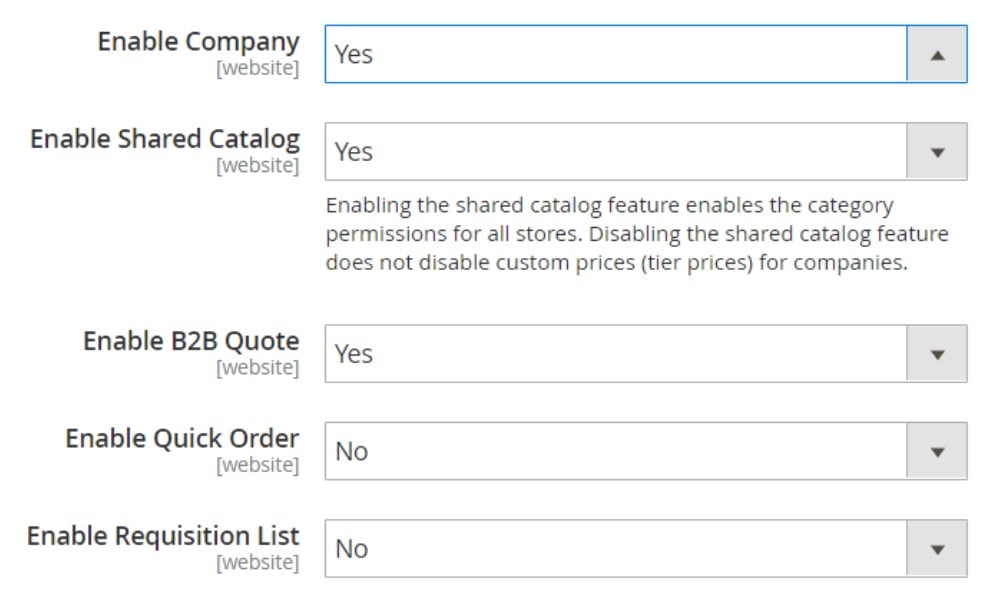
B2B functionality is one of the strongest arguments for choosing Adobe Commerce over Magento Open Source. While Open Source supports customer groups, tier pricing, and other features useful to wholesale businesses, Adobe Commerce offers a more complete B2B purchasing environment through its dedicated B2B functionality.
At the center of this environment are company accounts. Instead of treating each shopper as an independent customer, Adobe Commerce lets businesses create accounts representing entire organizations, with multiple employees, purchasing roles, and permissions.
These accounts connect several important features:
- Shared catalogs provide different companies with customized product assortments and negotiated pricing.
- Negotiable quotes let buyers and sales representatives discuss quantities, discounts, and pricing before completing an order.
- Purchase orders and approval rules support internal purchasing procedures, spending limits, and authorization requirements.
- Quick orders simplify bulk purchasing when customers already know the required product SKUs.
- Requisition lists let buyers save frequently ordered products and reuse them for future purchases.
- Company credit supports purchases against configured credit limits instead of requiring immediate payment.
Consider a manufacturer supplying equipment to several distributors. Each distributor may have its own product assortment and pricing, while individual employees require different spending permissions. Adobe Commerce can connect these requirements within a unified company purchasing workflow.
Magento Open Source can support similar operations using B2B extensions for company accounts, quotes, catalog restrictions, and purchasing approvals. The challenge is ensuring that these modules work together consistently, particularly when multiple vendors are involved.
Adobe Commerce also offers an advantage when B2B operations require extensive data exchange. Companies, shared catalogs, quotes, and requisition lists may need to synchronize with external enterprise systems.
For a closer look at these workflows, see our Adobe Commerce B2B features guide, which also explains how to import and export B2B entities.
Customer Segmentation, Personalization, and Advanced Promotions

Both Magento editions support customer groups, catalog price rules, cart price rules, and coupon-based promotions. However, Adobe Commerce takes personalization further by combining dynamic customer segmentation with targeted marketing and merchandising functionality.
The difference begins with how customers are classified.
In Magento Open Source, customer groups are commonly used to assign pricing, discounts, and purchasing conditions. Adobe Commerce adds customer segments that can dynamically include or exclude shoppers based on their behavior and other attributes.
For example, a merchant can define segments based on customers who have recently purchased particular products, shoppers with qualifying cart contents, or customers from specific geographic locations.
These segments can influence several Commerce-exclusive features:
- Targeted cart promotions: Offer discounts to shoppers who meet specific segmentation conditions.
- Dynamic blocks: Display different promotional banners, messages, or other content to different audiences.
- Related product rules: Automatically select cross-sells, up-sells, and related products according to merchandising rules and customer segments.
- Automated email reminders: Send follow-up messages under configured conditions, such as qualifying abandoned shopping carts or wish lists.
Adobe Commerce also includes private sales and catalog events, enabling merchants to organize limited-time promotions, invite selected customers, restrict access, and display event countdowns.
For example, a fashion retailer could create an exclusive sale for returning customers, display personalized promotional content, and recommend complementary products based on predefined rules.
Magento Open Source merchants can introduce comparable features through customer segmentation, advanced promotions, automatic related products, and marketing automation extensions.
The practical difference is integration. Adobe Commerce provides a native framework connecting customer segments with multiple promotional and merchandising tools. On Open Source, merchants may need to combine several extensions to create a similarly coordinated customer experience.
Content Staging, CMS Page Hierarchy, and Content Management
Content management is another important distinction in the Magento Open Source vs Adobe Commerce features comparison.
Both editions include Page Builder, which allows administrators to create CMS pages, banners, content blocks, and visual layouts without writing HTML manually.
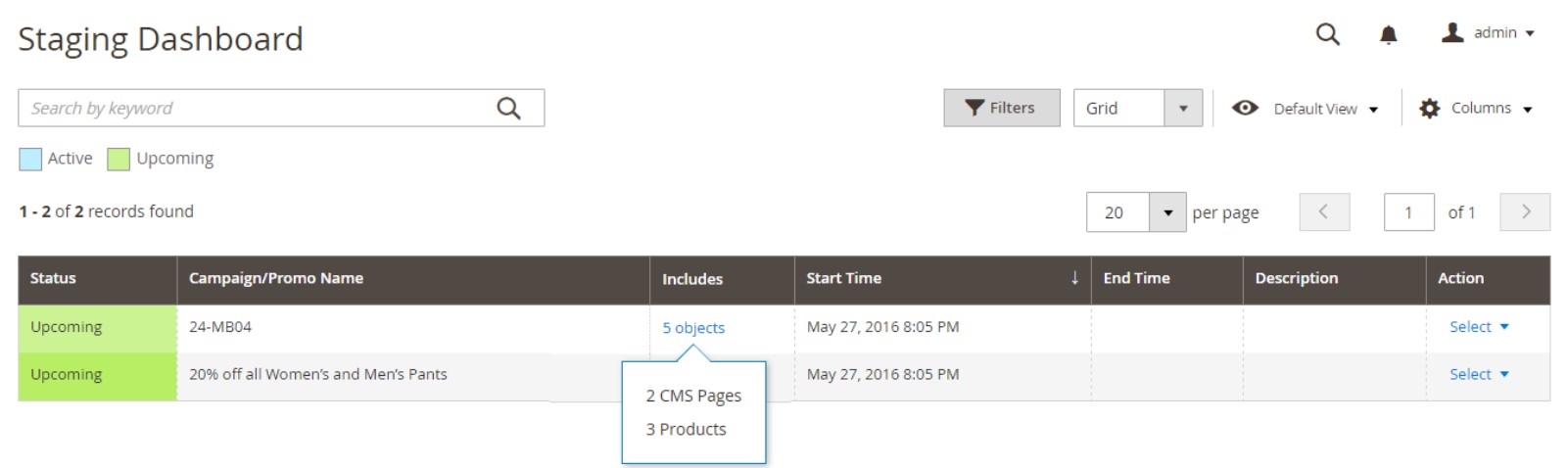
Adobe Commerce adds Content Staging and Preview, allowing merchants to prepare, schedule, and coordinate changes before publishing them to the storefront.
Instead of updating each product, category, price rule, and CMS element separately, administrators can combine multiple changes into a scheduled campaign.
Imagine preparing a Black Friday promotion. The marketing team needs to update homepage banners, product descriptions, category content, and promotional rules at midnight. With Adobe Commerce Content Staging, these modifications can be prepared in advance and assigned to a campaign with specific activation dates.
Administrators can also preview the upcoming storefront changes, share previews for approval, review scheduled updates on a calendar, and restore baseline content when a temporary campaign expires.
This reduces manual intervention during important sales events and helps prevent inconsistencies between promotional materials and actual product offers.
Our Magento 2 Content Staging guide explains these workflows and describes how to transfer staging data between Adobe Commerce environments.
Another Commerce-exclusive capability is CMS Page Hierarchy. It allows administrators to organize content into parent-child structures, create navigation menus, and manage relationships between pages.
This is especially useful for stores publishing extensive educational materials, buying guides, documentation, or structured content collections.
Magento Open Source can reproduce parts of these capabilities through scheduled CMS extensions, automation tools, and custom navigation development. However, coordinating multiple changes into a single previewable, reversible campaign generally requires more extensive customization.
Visual Merchandising, Category Permissions, and Catalog Management

Magento Open Source provides all the essential tools for organizing products into categories, assigning product positions, and configuring storefront navigation.
Adobe Commerce extends these capabilities through Visual Merchandiser, automated category rules, and advanced category permissions.
Visual Merchandiser provides a more convenient interface for arranging products. Instead of working primarily with product lists and position values, administrators can view products as visual tiles and adjust their placement through drag-and-drop controls.
More importantly, Adobe Commerce supports rule-based category assignments.
For example, a merchant can configure a category to include products matching selected attributes, such as brand, material, or price range. This reduces the need to manually maintain product associations as the catalog changes, although category rules may still require updates or reprocessing when catalog data changes.
These capabilities are particularly helpful for large product catalogs, where manually organizing thousands of SKUs becomes impractical.
Adobe Commerce also includes category permissions, which allow merchants to control how different customer groups interact with catalog content. Depending on the configuration, administrators can restrict category visibility, hide prices, or prevent certain customers from adding products to their carts.
This is useful for wholesale stores, membership-based catalogs, and businesses selling products only to authorized customer groups.
Magento Open Source offers comparable functionality through visual merchandising, automatic category, and catalog restriction extensions.
However, merchants should distinguish between category permissions and B2B shared catalogs. Category restrictions control access to catalog content, while shared catalogs support more extensive company-specific assortments and pricing configurations.
Both approaches can be useful, but they solve different business problems.
Customer Loyalty: Store Credit, Reward Points, Gift Cards, and Registries

Adobe Commerce provides several native features designed to improve customer retention, encourage repeat purchases, and simplify gift-related shopping experiences.
These capabilities are not included in Magento Open Source by default, although comparable solutions are available through third-party extensions.
One important example is store credit, which allows merchants to maintain monetary balances in customer accounts.
Instead of issuing a conventional payment refund, a merchant can return the corresponding amount to the customer’s store credit balance. The customer can then use that balance toward future purchases.
This creates a convenient alternative for handling returns and compensations, particularly when customers intend to continue shopping with the same retailer. Our Magento 2 Store Credit guide explains how this functionality differs between Magento Open Source and Adobe Commerce.
Other exclusive customer engagement capabilities include:
- Reward points: Customers earn points for eligible purchases and activities and redeem them according to configured exchange rates.
- Gift cards: Merchants can sell physical and virtual gift cards with unique redemption codes and trackable balances.
- Gift registries: Shoppers create event-specific product lists for weddings, birthdays, and other occasions, while invited guests can purchase items from those lists.
- Multiple wish lists: Customers organize saved products into separate lists instead of maintaining only one default wish list.
- Advanced gift options: Merchants can configure additional gift wrapping, messaging, and receipt functionality.
These features support different customer retention strategies. Reward points encourage recurring purchases, store credit keeps refunded value available for future orders, and gift cards introduce new customers through existing buyers.
Magento Open Source merchants can implement similar functionality using dedicated loyalty, gift card, store credit, and registry extensions.
However, combining several solutions requires additional attention to checkout compatibility, customer account balances, refund logic, and interactions between different payment methods.
Order Management, Returns, and Customer Service
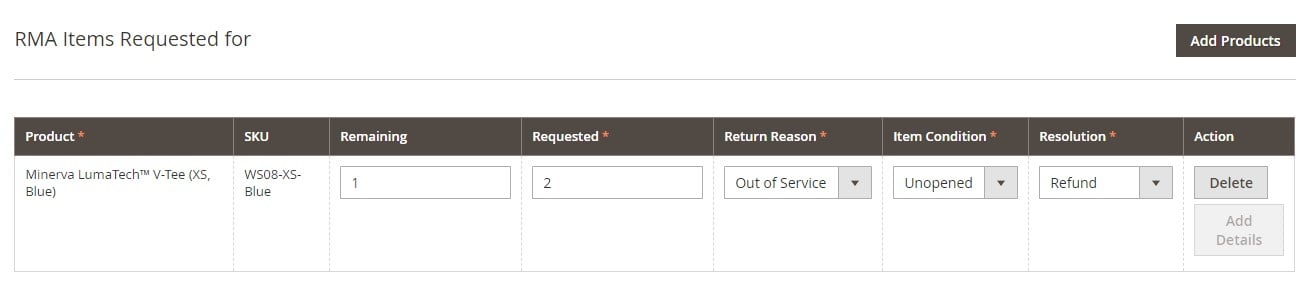
Both Magento Open Source and Adobe Commerce include comprehensive order management functionality. Merchants can process orders, generate invoices, manage shipments, create credit memos, and issue refunds.
The difference becomes more noticeable when businesses need structured return workflows and tools for managing large volumes of historical orders.
Adobe Commerce includes a native Return Merchandise Authorization (RMA) system that allows customers to submit return requests from the storefront.
Administrators can review requests, approve or reject individual items, specify return reasons and conditions, and manage the return process through defined statuses.
The platform also supports custom return attributes, allowing businesses to collect additional information about returned merchandise.
For example, an electronics retailer might require customers to specify whether a product is defective, unopened, or damaged before approving a return.
Magento Open Source supports refunds and credit memos but does not provide the same native RMA management workflow. Merchants can add comparable functionality using third-party return management extensions.
Another Commerce-exclusive feature is order archiving.
Adobe Commerce can automatically move completed or otherwise eligible orders, along with related invoices, shipments, and credit memos, into an archive. This helps administrators concentrate on active orders without deleting historical records.
Open Source merchants can implement similar administrative archiving through dedicated modules or custom solutions.
Both editions also support customer assistance and administrative order creation, so these basic operations should not be treated as exclusive Adobe Commerce capabilities.
The broader advantage of Adobe Commerce lies in providing more advanced order-related workflows within the native platform, reducing the number of separate tools needed for customer service operations.
Scheduled Import/Export, Automation, and Third-Party Integrations
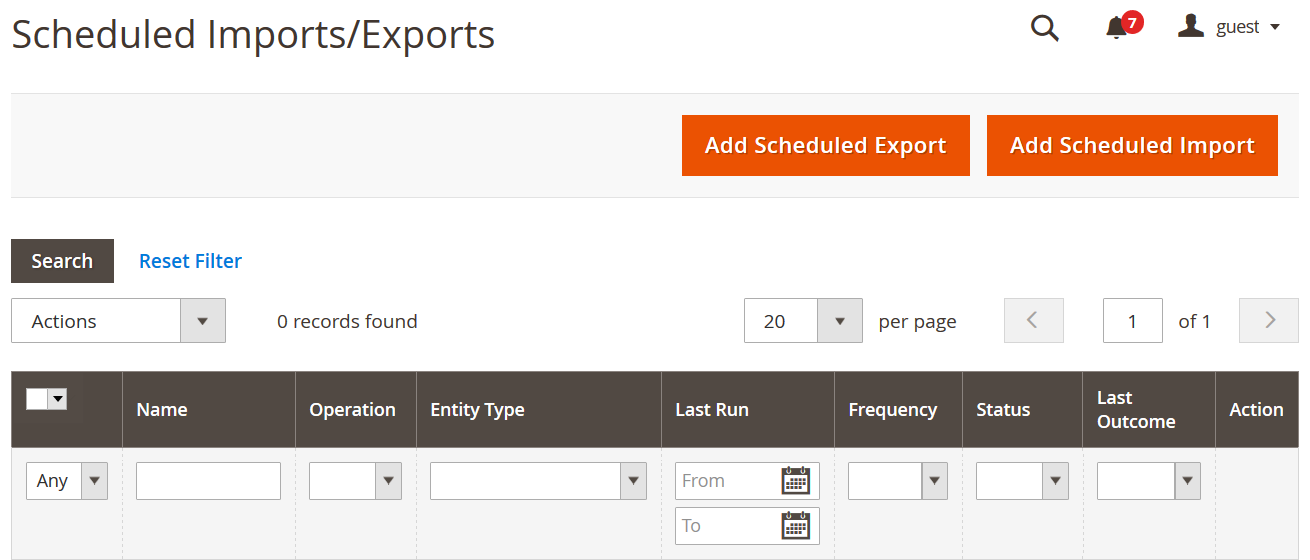
Data management is an area where the difference between Magento Open Source and Adobe Commerce is particularly noticeable — although both editions can be extended far beyond their native capabilities.
Magento Open Source includes basic CSV import and export functionality. Administrators can transfer supported entities such as products, customers, and pricing data, but the standard interface does not provide a built-in scheduled import/export workflow.
Adobe Commerce introduces Scheduled Import/Export, which allows merchants to configure recurring data transfers using the platform’s cron scheduler.
Native scheduled jobs can run daily, weekly, or monthly and exchange supported data with local directories or remote FTP servers.
This is useful for recurring catalog updates, scheduled data extracts, and other predictable operations.
However, Adobe Commerce’s native scheduler still has limitations. It relies primarily on Magento-compatible CSV structures, supports a defined set of entities, and does not provide comprehensive data mapping or transformation capabilities.
For example, a supplier might provide XML files containing product information under field names that do not match Magento attributes. Neither edition can automatically process arbitrary external structures through its default importer.
This is where our Improved Import & Export Magento 2 Extension becomes relevant to both platforms. It introduces configurable import and export jobs with features such as:
- Automated schedules: Run recurring data transfers through cron instead of executing every job manually.
- Additional file formats: Work with CSV, XML, JSON, XLSX, and ODS.
- Attribute and value mapping: Match external data structures to Magento attributes without manually renaming every column.
- Data transformations: Apply default values, static values, filters, find-and-replace operations, and other supported adjustments.
- Additional import sources: Exchange information through FTP/SFTP, Google Sheets, Google Drive, direct URLs, and supported API connections.
- Extended entity support: Transfer categories, orders, product attributes, CMS content, MSI data, and additional supported entities beyond standard Magento imports.
Consequently, Open Source merchants can gain automation capabilities comparable to — and in several respects broader than — the native Adobe Commerce scheduler.
Adobe Commerce merchants can use the same extension to overcome limitations of their built-in tools.
This becomes especially important for Magento ERP, CRM, PIM, and accounting integrations, where external systems may exchange products, stock levels, customer information, prices, and orders using different formats and structures.
For example, an ERP might periodically provide updated inventory quantities while Magento sends newly placed orders back for fulfillment. These workflows require reliable field mapping, data validation, and automated synchronization.
Our Magento ERP integration guide for 2027 explores these scenarios and explains the available integration approaches.
Neither Magento Open Source nor traditional Adobe Commerce is restricted to file-based integration. Both provide APIs that developers can use to implement real-time connections, event-driven workflows, and custom middleware. The main difference is therefore not whether integration is possible, but how much additional functionality and development are required to implement the desired workflow.
Search, Product Recommendations, and Analytics
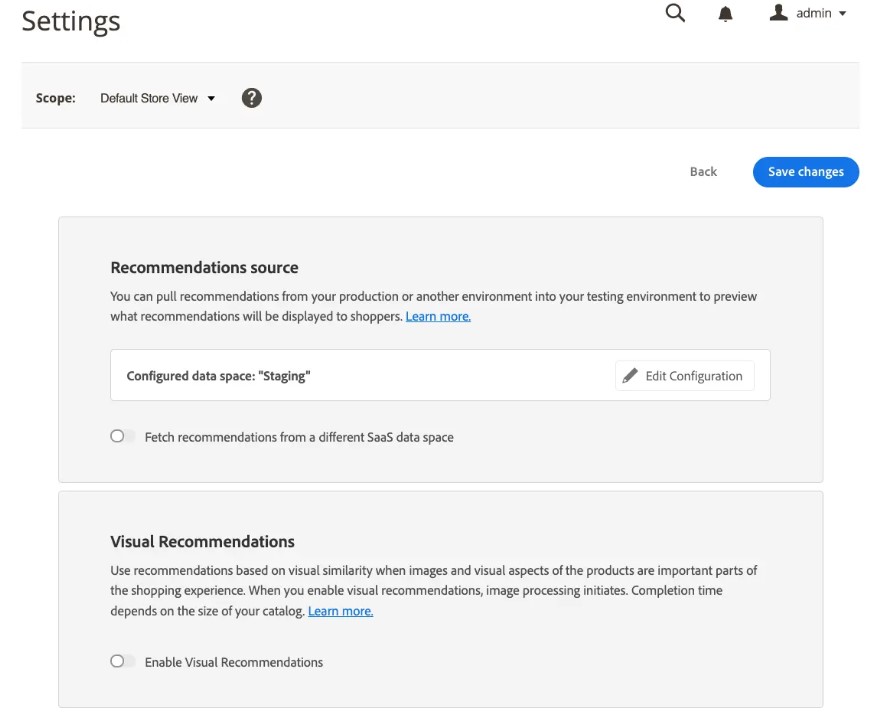
Both Magento editions provide product search capabilities, catalog filtering, and standard reporting tools. Adobe Commerce, however, offers additional merchandising services that can deliver more sophisticated search experiences and data-driven product recommendations.
One example is Adobe Live Search, which uses Adobe’s cloud-based search technology to provide intelligent search results, search-as-you-type functionality, faceting, and merchandising controls.
Rather than relying exclusively on the traditional Magento search configuration, merchants can use Live Search to improve product discovery and adjust how shoppers encounter relevant products.
Another Adobe service is Product Recommendations, which uses machine learning and behavioral data to generate personalized product suggestions.
For example, an electronics store could display complementary accessories based on browsing behavior, product relationships, and purchasing patterns instead of relying entirely on manually configured recommendations.
Magento Open Source merchants can implement comparable capabilities using advanced search extensions, recommendation engines, and external personalization services.
The analytics comparison requires an additional distinction.
Standard reporting and Advanced Reporting are available in both Magento Open Source and Adobe Commerce. Adobe Commerce also provides access to Commerce Intelligence capabilities, which support more extensive reporting, data modeling, dashboards, and analysis across multiple data sources.
Commerce Intelligence availability and functionality depend on the applicable subscription and account configuration.
Similarly, Live Search and Product Recommendations are Adobe Commerce services rather than ordinary features of the standard Magento application. They require appropriate eligibility, service connections, and configuration.
This distinction matters when comparing the platforms: a commercial Adobe Commerce license does not mean that every Adobe Experience Cloud product or third-party analytics service is automatically included.
Open Source merchants can build an advanced analytics stack using reporting modules, external BI platforms, and integrations. The trade-off is managing these tools separately instead of relying on a more integrated enterprise ecosystem.
Scalability, Security, Cloud Infrastructure, and Enterprise Support
Scalability is often presented as a major reason to upgrade from Magento Open Source to Adobe Commerce. However, Magento Open Source is not inherently limited to small stores, and Adobe Commerce does not automatically guarantee faster storefront performance.
Both platforms can support substantial catalogs, multiple storefronts, and high transaction volumes when properly configured and hosted.
Performance depends on factors such as infrastructure capacity, caching, search services, database optimization, custom code, extensions, and storefront architecture.
The more meaningful differences involve infrastructure management, operational responsibility, available services, and technical support.
Magento Open Source merchants are responsible for arranging their hosting environment, applying security patches, maintaining extensions, and monitoring platform performance. These tasks can be delegated to hosting providers or development agencies.
Adobe Commerce provides commercial support and additional enterprise tooling. However, infrastructure responsibilities vary significantly depending on the deployment model.
In 2027, it is particularly important to distinguish three Adobe Commerce options:
Adobe Commerce On-Premises
This traditional deployment provides the commercial Adobe Commerce application while allowing merchants to run it on their own infrastructure or through a third-party hosting provider.
Businesses retain extensive control over server configuration, PHP extensions, application code, and custom modules. They are also responsible for hosting operations, upgrades, patching, and performance maintenance.
Adobe Commerce on Cloud Infrastructure (PaaS)
The PaaS offering combines Adobe Commerce with Adobe-managed cloud infrastructure, deployment tooling, CDN capabilities, and monitoring services.
Adobe manages the underlying hosting platform, while merchants and their technical teams remain responsible for application-level maintenance, updates, customization, and extension compatibility.
This model is particularly attractive for businesses that want the traditional Adobe Commerce application and PHP extensibility without managing every infrastructure component independently.
Adobe Commerce as a Cloud Service or ACCS (SaaS)
Adobe Commerce as a Cloud Service uses a different architecture. It is a fully managed, versionless SaaS platform where Adobe handles core application updates, infrastructure management, and automatic scaling.
Unlike traditional Adobe Commerce installations, ACCS does not allow merchants to install arbitrary PHP modules directly into the application’s codebase.
Instead, customization relies on supported APIs, events, Adobe Developer App Builder, and other out-of-process extensibility mechanisms.
This distinction is essential when evaluating third-party extensions. For example, Improved Import & Export supports Magento Open Source, Adobe Commerce on-premises, and Adobe Commerce on cloud infrastructure (PaaS), but not ACCS.
The SaaS offering also differs from PaaS in certain storefront, content management, merchandising, and operational capabilities. Therefore, features available in traditional Adobe Commerce should not automatically be assumed to work identically in ACCS.
Security follows a similar pattern.
Both Magento Open Source and traditional Adobe Commerce receive security updates, and both require proper configuration, access management, monitoring, and secure custom development.
Adobe Commerce’s commercial support and managed infrastructure options can reduce certain operational burdens, but they do not eliminate the need for secure integrations, access controls, and ongoing maintenance.
Ultimately, the difference between Magento Open Source and Adobe Commerce scalability is less about a fixed technical limit and more about who manages the infrastructure, how the platform is customized, and which enterprise services are available.
Magento Open Source offers flexibility and infrastructure independence. Adobe Commerce introduces commercial support, additional native business features, and managed deployment options that may simplify enterprise operations.
Final Words: Magento Open Source or Adobe Commerce — Which Should You Choose in 2027?
The Magento Open Source vs Adobe Commerce comparison comes down to more than licensing costs or the number of available features. Both platforms provide a powerful ecommerce foundation, but they take different approaches to supporting growing business requirements.
Magento Open Source is an excellent choice for merchants who value flexibility, control, and cost efficiency. It provides the essential tools for managing products, customers, orders, and multiple storefronts without commercial licensing fees. When additional functionality becomes necessary, businesses can introduce it selectively through third-party extensions or custom development instead of paying for an extensive enterprise feature set they may never fully use.
Adobe Commerce makes more sense for businesses that need advanced capabilities working together out of the box. Its native B2B purchasing workflows, customer segmentation, content staging, visual merchandising, loyalty features, and commercial support can justify the higher investment, particularly for complex wholesale operations and larger organizations.
However, choosing Magento Open Source doesn’t mean giving up enterprise-level automation and integrations. Likewise, choosing Adobe Commerce doesn’t eliminate every limitation of its native tools.
This is especially true for data management. Both platforms can benefit from Improved Import & Export by Firebear, which expands native functionality with scheduled data transfers, flexible attribute mapping, additional file formats, and connections to ERP, CRM, PIM, supplier platforms, and other external systems.
Whether you’re building an affordable Magento Open Source store or managing a complex Adobe Commerce environment, the best approach is to choose the platform that meets your core requirements and extend it only where additional functionality delivers measurable value.
Explore Improved Import & Export to automate data exchange, simplify integrations, and make your Magento ecommerce operations more efficient — regardless of which edition you choose.
Magento Open Source vs Adobe Commerce FAQ
1. What Is the Main Difference Between Magento Open Source and Adobe Commerce?
The main difference between Magento Open Source and Adobe Commerce is the availability of enterprise functionality and commercial support. Magento Open Source is a free, open-source ecommerce platform with essential tools for managing products, customers, orders, and storefronts. Adobe Commerce is a paid solution that adds advanced B2B capabilities, customer segmentation, content staging, loyalty programs, and merchandising tools. Both share the same core technology, but Adobe Commerce offers more integrated functionality for complex business operations.
2. Is Magento Open Source Free, and How Much Does Adobe Commerce Cost?
Magento Open Source is free to download and use, but merchants must pay for hosting, development, maintenance, and any commercial extensions they require. Adobe Commerce uses subscription-based licensing with customized pricing rather than publicly advertised fixed rates. Costs depend on business requirements, deployment model, and contract terms. Businesses should compare the total cost of ownership, including implementation, infrastructure, integrations, and ongoing support, rather than licensing expenses alone.
3. What Features Does Adobe Commerce Have That Magento Open Source Doesn’t?
Adobe Commerce includes several exclusive features, such as advanced customer segmentation, content staging, visual merchandising, reward points, store credit, gift cards, gift registries, category permissions, native returns management, and scheduled imports and exports. Additional B2B functionality, including company accounts, shared catalogs, negotiable quotes, and purchase approval workflows, is available through Adobe Commerce B2B. Magento Open Source can reproduce many of these capabilities using third-party modules, although functionality and integration depth may differ.
4. Can Magento Open Source Offer the Same Features as Adobe Commerce?
Magento Open Source can offer many Adobe Commerce features through third-party extensions and custom development, including B2B purchasing tools, customer loyalty programs, advanced promotions, and automated data transfers. However, achieving identical functionality is not always possible or cost-effective. Some Adobe Commerce capabilities, particularly coordinated content staging, enterprise services, and commercially supported infrastructure, may require extensive customization or alternative solutions. Merchants should evaluate the specific functionality they need rather than attempt to reproduce every enterprise feature.
5. Is Adobe Commerce Better Than Magento Open Source for B2B Ecommerce?
Adobe Commerce is generally better suited to complex B2B ecommerce operations because its dedicated B2B package provides integrated company accounts, shared catalogs, negotiable quotes, requisition lists, quick ordering, and purchase approval workflows. The Adobe Commerce B2B extension requires a separate license. Magento Open Source can also support wholesale and B2B sales using customer groups, tier pricing, specialized extensions, and custom integrations. It may be more cost-effective for businesses with simpler purchasing requirements.
6. Does Magento Open Source Support Page Builder and Multi-Source Inventory?
Yes. Both Magento Open Source and Adobe Commerce support Page Builder and Multi-Source Inventory (MSI). Page Builder has been included in Magento Open Source since version 2.4.3, enabling drag-and-drop content creation. MSI allows merchants to manage inventory across multiple warehouses, assign sources to stocks, and calculate salable quantities. These are shared Magento features, although Adobe Commerce provides additional content management capabilities, including staging, preview, and personalized content.
7. Can Magento Open Source Automate Imports and Exports?
Yes, but Magento Open Source does not include native scheduled import/export functionality. Its built-in tools primarily support manual CSV transfers. Merchants can automate these operations using extensions such as Firebear Improved Import & Export, which supports cron schedules, attribute mapping, data transformations, additional formats such as XML, JSON, and XLSX, and connections to external data sources. Adobe Commerce includes a native scheduled import/export tool, but it can also benefit from these additional capabilities.
8. Is Adobe Commerce More Secure and Scalable Than Magento Open Source?
Not necessarily. Both Magento Open Source and Adobe Commerce can support large, secure ecommerce websites when properly configured, maintained, and hosted. Both receive security updates, but Adobe Commerce additionally offers commercial support, enterprise services, and managed cloud deployment options. Adobe Commerce on cloud infrastructure (PaaS) reduces some hosting responsibilities, while Adobe Commerce as a Cloud Service (SaaS) provides a more fully managed environment. Actual performance and security depend on architecture, infrastructure, extensions, maintenance, and operational practices.
9. Can You Upgrade From Magento Open Source to Adobe Commerce?
Yes. Merchants can upgrade an existing Magento Open Source installation to Adobe Commerce without necessarily rebuilding their entire ecommerce website. For traditional Adobe Commerce deployments, the process involves obtaining a commercial license, replacing the Open Source Composer package, upgrading the application and database, and configuring additional Commerce modules. Existing extensions, themes, integrations, and customizations must be checked for compatibility. Moving to Adobe Commerce as a Cloud Service requires a different migration approach because of its SaaS architecture and extensibility model.
10. Which Is Better for a Growing Ecommerce Business: Magento Open Source or Adobe Commerce?
Magento Open Source is often the better choice for businesses seeking flexibility and lower licensing costs, especially when their requirements can be addressed with a manageable number of extensions. Adobe Commerce becomes more attractive when advanced B2B workflows, personalization, merchandising, and enterprise support justify its higher costs. The right choice depends on the company’s budget, technical resources, operational complexity, and growth plans. Many businesses can scale successfully with Magento Open Source before considering a commercial upgrade.
Related posts
 How to Choose a Magento 2 Data Import Tool for Magento Open Source & Adobe Commerce in 2026
 Magento 2 (Adobe Commerce) Pricing Explained
 Magento 2 System Requirements: Complete Guide for Adobe Commerce and Open Source
 Adobe Commerce Integrations Guide: Native Features, Third-Party Tools & Best Practices in 2026
 Magento 2 B2B Company Explained: A Complete Guide to Setup, Structure, Management & Import for Adobe Commerce
 Magento 2 Release Notes: Adobe Commerce & Open Source Updates
 How to Import Customers & Customer Addresses to Magento 2 in 2026: Complete Tutorial & CSV Samples for Adobe Commerce & Magento Open Source
 Magento 2.4.9 Upgrade: What’s New, Import & Export Improvements, and Third-Party Extension Compatibility